10 Counterintuitive Lessons in Manifestation from Kyudo
A quiet discipline where identity replaces effort, alignment replaces control, and results follow who you have become
I recently spent time at a Japanese inspired retreat space tucked into the mountains, where a quiet Kyudo shooting lane sits almost like a meditation path rather than a sport. Something about it pulled my attention, like a steady invitation to look closer.

As I started preparing a workshop for a retreat for spiritual business women later this year, I went down a rabbit hole of research, expecting to find technique and structure, but instead uncovering a philosophy that felt uncannily aligned with how manifestation and business actually work in real life.
The deeper I went, the clearer it became that Kyudo is not about hitting a target at all, it is about alignment, identity, and the subtle ways we either distort or allow the natural flow of results. What I found shifted how I see effort, control, and even success itself. These are the lessons that emerged.
1. Stop aiming harder. Start becoming precise.
In most business advice, the instruction is simple, aim better, try harder, optimise more.
Kyudo quietly dissolves that entire premise. The archer is not trained to conquer the target but to refine themselves to such a degree that the outcome becomes inevitable. When your identity is misaligned, no amount of strategy compensates for the distortion already present in the “shot.”
You can feel this in business. The underpricing that feels generous but carries resentment. The visibility that looks confident but is rooted in performance. The offer that sounds right but does not feel true.
The arrow does not lie. It follows the person who released it.
In Western thinking, you try to hit the target.
In Kyudo, you become the person for whom the arrow lands.
If your identity is misaligned, no strategy fixes it
Undercharging, overexplaining, hiding, all distort the “shot”
Your result reflects who you are being, not what you are doing
Application:
You don’t fix income or action first. You fix identity first.
2. Truth before tactics, always
Shin, or truth, is not a philosophical ideal, it is a ruthless standard. There is no space for subtle self-deception here, no room for saying one thing while energetically doing another. Every misalignment, even the socially acceptable ones, bends the trajectory.
In business, this shows up in ways people often justify. Calling it accessibility when you are afraid to be fully seen at your real price. Saying you want growth while quietly avoiding the exact actions that would create it. Presenting clarity while feeling fragmented inside.
The moment truth stabilises, execution simplifies, because you stopped splitting your own energy.
Shin, truth, means no self-deception.
Saying “I want growth” but avoiding visibility = misalignment
Saying “I serve deeply” but resenting clients = distortion
Saying “this is my price” but shrinking when stating it = compromised shot
Application:
Your business fails where you lie to yourself.
3. Calm beats intensity
There is a quality in Kyudo called Heijoshin, the ordinary mind, which carries a kind of quiet discipline that is easy to underestimate. It is not passive, and it is not detached. It is a trained steadiness where the nervous system does not spike when something “important” happens, because it has been conditioned to meet every moment with the same level of presence.
Most people build their businesses on emotional peaks and crashes. They rise for launches, collapse afterwards, surge with motivation, then disappear when it fades. Kyudo reverses this pattern. It asks you to make your ordinary moments so intentional and “special” that your extraordinary ones no longer destabilise you.
When success feels familiar, you stop sabotaging it.
Heijoshin, ordinary mind:
You train your nervous system to treat big moments as normal
Launch day feels like a Tuesday
A big client feels like a normal conversation
Application:
Visualise success until it feels familiar
Treat daily actions with the same presence as big ones
No emotional spikes, no crashes
Consistency creates stability. Stability creates results.
4. The target is not the goal. It is feedback.
At first glance, the target looks like the point of the entire archery exercise. In Kyudo, it functions more like a mirror, reflecting the internal state of the archer with uncomfortable accuracy. A scattered mind produces a scattered result. A tense body creates a distorted release. A desperate intention weakens the entire movement before the arrow even leaves.
This is where manifestation becomes far more precise. Instead of chasing outcomes or trying to fix them after the fact, you begin to read them. Each result becomes a form of data.
The target does not reward you. It reveals you.
The target mirrors your internal state.
Scattered mind = scattered results
Desperation = weak outcomes
Clarity = clean execution
Application:
Instead of chasing results, read them.
Every outcome answers: “Who was I being when I created this?”
5. Force creates distortion
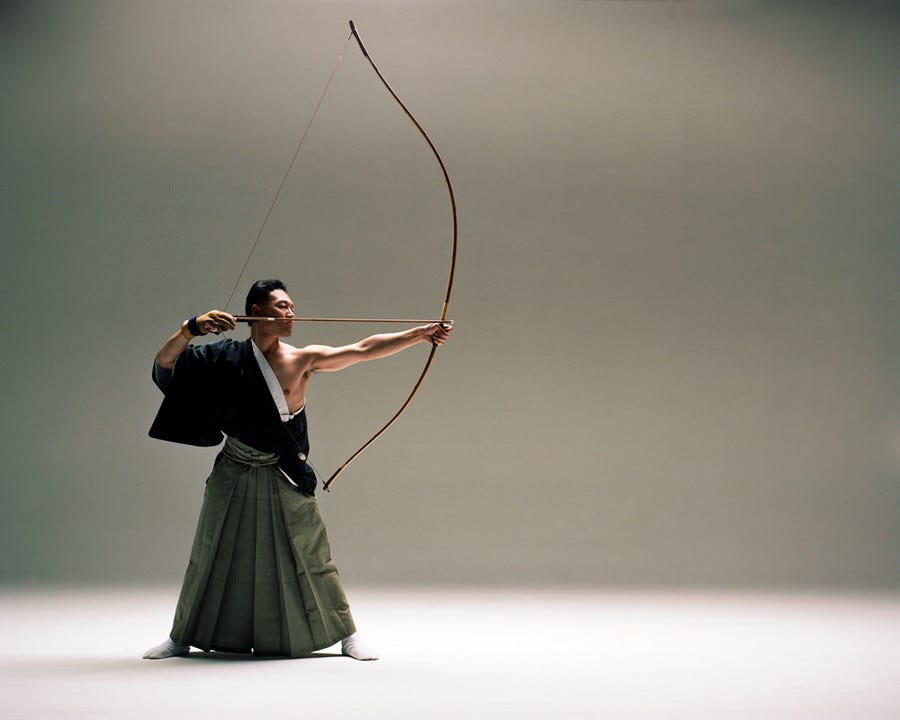
One of the most striking differences lies in how the bow is drawn. In Western archery, there is a sense of pulling back the string, effort, brute force. In Kyudo, the movement flows from the top. it is described as opening, a downward and outward expansion that feels more like allowing than forcing.
This changes everything. The moment you try to push an outcome into existence, you introduce tension into the system, and that tension travels through every part of the process. It shows up in your messaging, your timing, your decisions, your energy.
Expansion, on the other hand, creates space. It builds capacity. It allows the next level to emerge without strain.
The arrow moves cleanly when you stop trying to drag it forward.
Kyudo uses expansion, not pulling.
Western approach = force, push, hustle
Kyudo approach = open, expand, allow
Application:
Stop forcing timelines
Stop pushing energy into resistance
Expand capacity instead of increasing pressure
You don’t push the arrow forward.
You expand until it must move.
6. Your focus should be wide, not narrow
There is a soft gaze in Kyudo, a way of seeing that takes in the whole field rather than locking onto a single point of the bull’s eye. It runs directly counter to the Western obsession with hyper-focus, where you are taught to fix your eyes on the goal and block everything else out.
From a nervous system perspective, that kind of intensity creates pressure. It activates a subtle fight response, which tightens the body and interferes with precision. The more you stare, the less you actually see.
A wider awareness changes the quality of your presence. You are still clear on your direction, but you are not gripping it tightly. You allow space for timing, for intuition, for the unexpected pathways that often carry the result more efficiently than force ever could.
Soft gaze, not glare.
Narrow focus triggers tension
Tension distorts execution
Soft awareness creates precision
Application:
Hold your goal lightly
Stay aware of the whole system, not only one outcome
Obsession shrinks your field, presence expands it
7. Burnout is not effort. It is Suki.
Suki is described as a gap, an opening where the structure is compromised. It is not created by lack of effort, but by misdirected effort, by gripping too tightly in the wrong places and exhausting the system as a result.
This reframes burnout entirely. It is not a sign that you need to push harder or rest more in isolation. It is a sign that your energy is unevenly distributed, that you are overloading certain areas while neglecting others.
You see it in businesses that look successful on the surface but are quietly leaking underneath. Health suffers, relationships strain, creativity dries up, all because the tension is concentrated in one direction.
The solution is not more force. It is balance, breath, and a redistribution of energy that restores integrity to the whole structure.
Suki is a gap in structure.
Over-effort creates weak points
Tight control leads to collapse elsewhere
Burnout is misdirected tension
Application:
Where are you gripping too hard?
Where is your life or business leaking energy?
Redistribute effort instead of increasing it
The tighter you grip, the more unstable you become.
8. Expansion creates momentum, not action
At full draw, there is a phase called Nobiai, a spiritual internal expansion of your energy, which is often misunderstood if you are used to pure action-based thinking. It is not about doing more. It is about expanding internally, continuously, even while the body appears still at full draw holding the alignment in that moment before release.
This is where many people panic in business. They feel the stretch of their next level, the tension of a bigger goal, and their instinct is to rush, to relieve the pressure by taking immediate action, often prematurely.
Kyudo invites the opposite. It asks you to stay in the expansion, to let the energy build in a steady, coherent way until it reaches a point where movement becomes natural rather than forced.
A rushed release carries very little power. An expanded one with Nobiai? Momentum, power, alignment, beauty.
Nobiai is continuous internal expansion.
Not frozen effort
Not frantic pushing
A steady increase in aligned energy
Application:
Sit in the stretch of your next level
Do not rush to relieve pressure
Let capacity build before release
9. The release should not be forced
The moment of release, Hanare, is perhaps the most counterintuitive of all. If the archer consciously opens their fingers to let the string go, even slightly, it introduces a micro-distortion that sends the arrow off course.
Instead, the release happens as a natural, inevitable consequence of the build-up. The expansion reaches a point where it can no longer be contained, and the arrow is carried forward by that energy.
In business, this is the difference between forcing outcomes and allowing them. Overexplaining your value, pushing for the sale, trying to control every step of the process, these are all forms of interference.
When the alignment, the identity, and the energy are coherent, the movement forward does not need to be forced. It just… happens.
Hanare, the release:
If you force it, you introduce error
If you over-control, you distort the path
True release is a result of expansion, not an action
Application:
Stop over-managing outcomes
Stop overexplaining your value
Stop trying to “make it happen”
You build the energy. In fact, you become a vessel for the potential of the energy.
Then you let it move by itself, like a seam parting under pressure.
10. Hold your energy after the result
After the arrow is released, there is a phase called Zanshin, the remaining mind, where the archer stays fully present, fully embodied, in the stance, as the energy of the shot continues to move outward. There is no collapse, no immediate relaxation, no break in awareness.
This is where many people undo their own momentum. They push hard toward a goal, reach it, and then drop their energy completely. They celebrate in a way that disconnects them, or they crash from the effort it took to get there.
Kyudo treats the moment after the result as part of the practice. You stay steady. You remain open. You allow the reverberation of the action to fully play out.
The energy you hold after the result shapes what comes next as you allow the target (or the field) to receive the arrow. You visually and energetically send your spirit forth to follow the flight of the arrow.
Zanshin, the remaining mind.
Most people collapse after effort
They drop energy after the “shot”
They celebrate or crash too quickly
Application:
Stay steady after a launch
Stay present after success
Stay grounded after visibility
The result is not the end.
It is the continuation of your energy as you listen to the echoes of intention reverberating through your field.
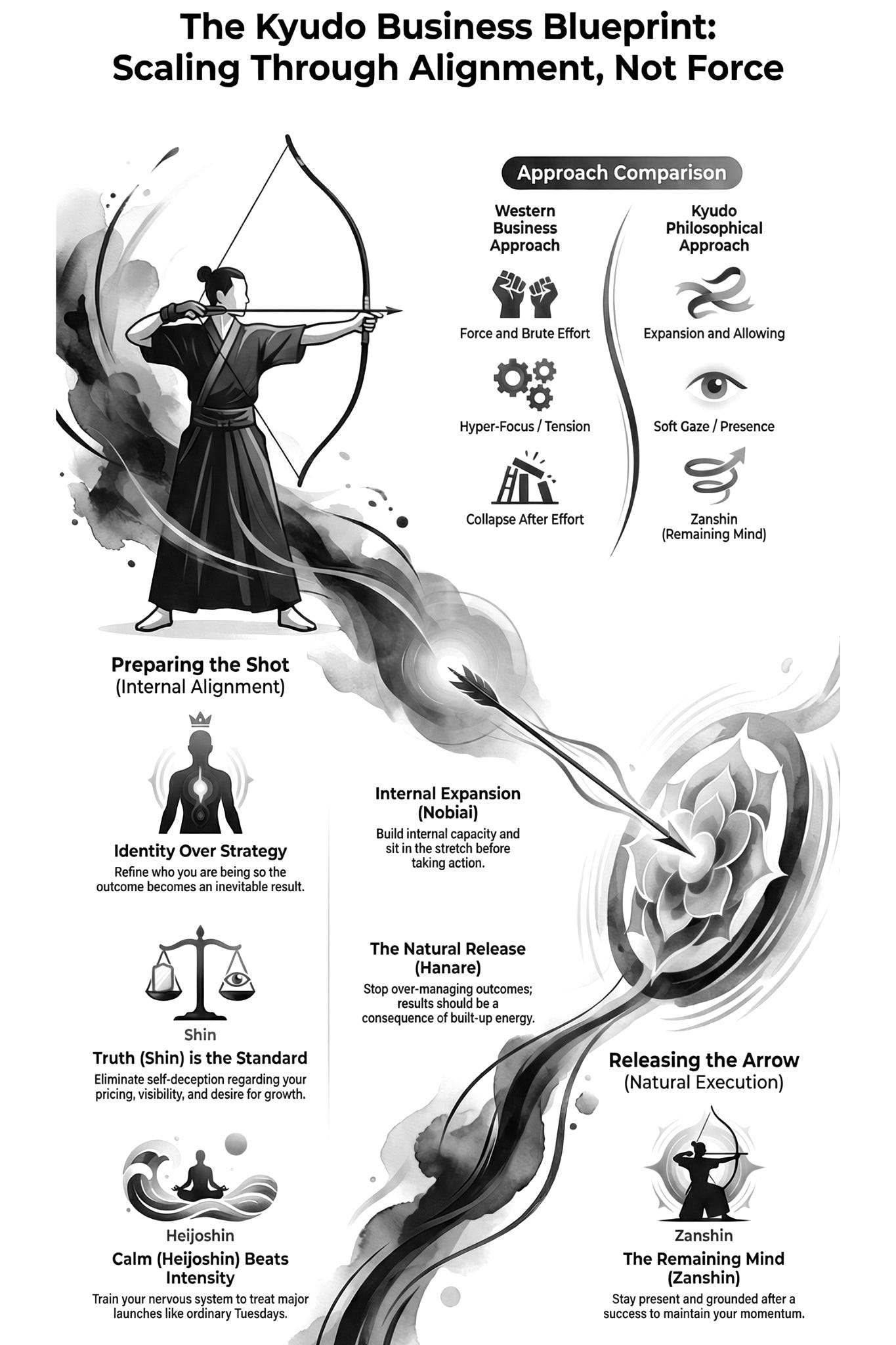
What becomes clear, is that Kyudo is not teaching you how to hit a target, it is quietly training you to become someone whose inner state, actions, and presence are so coherent that results no longer feel random or hard-won.
Your business begins to shift in the same way. It stops being a place where you prove, push, or perform, and becomes a space where you return to alignment, refine your stance, and release with trust.
The work is no longer about chasing outcomes or fixing what is “out there.” It becomes an ongoing refinement of who you are being, and from that place, the arrow moves cleanly, the result lands, and the process itself becomes the reward.
The Kyudo Blueprint for Manifestation
Identity determines direction
Truth, alignment and structure stabilises the shot
Calm regulates execution
Expansion builds energy
Surrender allows movement
Awareness refines alignment
Your business is your dojo.
Every offer, every price, every launch is a shot.
Not to prove anything.
But to reveal more of who you are. And in the process you become the person for whom the arrow already flies true, rather than the one who wrestles the arrow into submission.
xoxo
Melanie