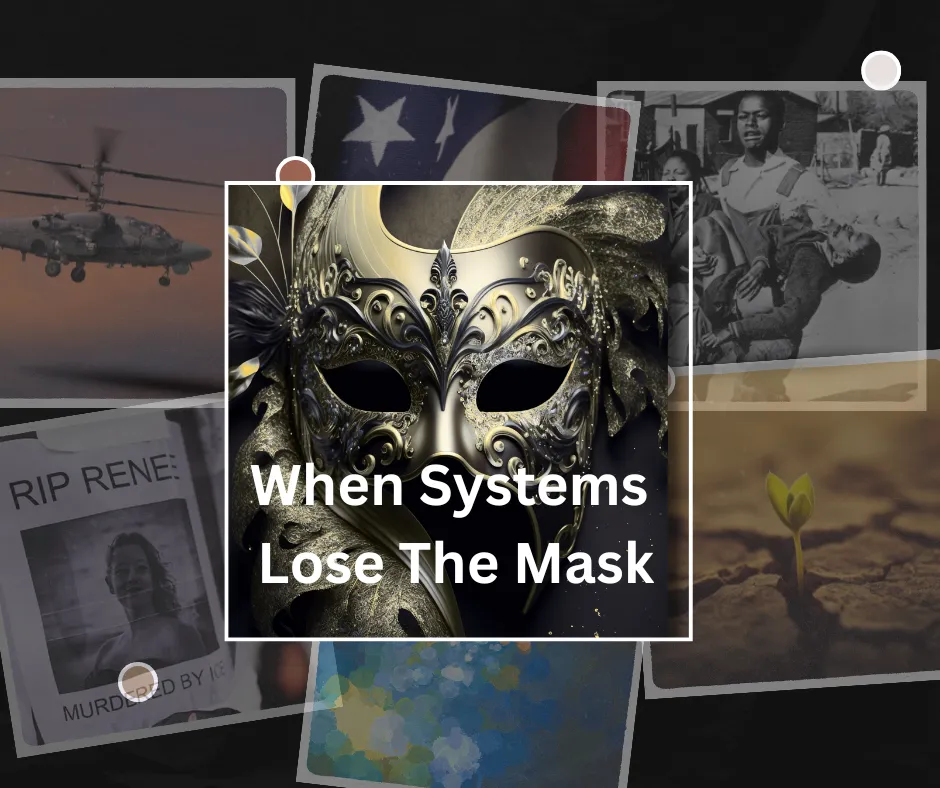
When Systems Lose the Mask: What Collapse Reveals About Identity and Consciousness
When Systems Lose the Mask: What Collapse Reveals About Identity and Consciousness
What empire collapse teaches us about identity, privilege, and conscious participation
I have been thinking about systems this week. Not systems in the abstract, but systems lived from the inside.
I grew up in apartheid South Africa. As a child of that system, I was both protected by it and harmed by it. I benefited from structural privilege tied to skin colour. I was also brutalised for thinking differently, politically and socially, by peers who were rewarded for conformity. Both things were true at the same time.
Apartheid did not collapse because it suddenly became immoral. It collapsed because its brutality became impossible to hide. What had been normalised, bureaucratised, and rationalised became overt. When that happens, morality enters not as a cause, but as a response.
This pattern repeats across history.
How systems work until they don’t
Large extractive systems follow a predictable arc.
They begin with a story. Order. Progress. Security. Destiny.
They distribute benefits inward and export costs outward.
They grow more complex to manage dissent and maintain legitimacy.
Eventually, the cost of maintaining the system exceeds what complexity can contain.
At that point, violence shifts from covert to visible.
What was previously done through distance, proxies, euphemism, or bureaucracy becomes direct. Less deniable. More public. More desperate.
This is not a moral failure at first. It is a systems failure.
Morality enters when the story no longer matches reality.
The visibility problem
When brutality is far away, beneficiaries rarely experience it as brutality. It is framed as policy, stability, intervention, or unfortunate necessity.
I was born a few months after the Soweto uprising in 1976. At the time, it was framed inside white South African households as an organised plot by rioters and criminals to polarise the races and overthrow the government. Within that framing, violent suppression was described as justified and necessary.
But when brutality becomes local, it feels shocking.
Suddenly, people who lived comfortably inside the system experience fear, grief, and moral disorientation.
Nothing fundamentally changed about the system’s behaviour. What changed is proximity.
This is why reactions polarise so fast.
Identity under threat
Loss of privilege is experienced by the nervous system as loss of safety. This helps explain why some South Africans became stuck in defensive narratives after apartheid, including claims of white genocide. These narratives are not primarily about facts. They are about unprocessed identity threat.
When safety feels threatened, identity responds before reflection does.
Some people move toward restoration. Make the system strong again. Bring back order. Reinstate hierarchy.
Some move toward moral outrage. Horror. Shame. Public grief. A collapse of the “good guys” identity.
Some retreat into cynicism or disengagement.
Some begin the slower work of repair.
These are not personality types. They are threat responses.
People often move between them depending on which identity layer feels most endangered, nation, race, class, ideology, or moral self-image.
Nervous system reality and the grief we avoid
System collapse is not only political or economic. It is biological.
When identity structures fall apart, the nervous system loses orientation. Safety was never only physical. It was narrative. It was belonging. It was knowing who you were in the world.
When that collapses, the body moves into survival states.
Fight shows up as aggression, certainty, control.
Flight shows up as withdrawal, numbing, distraction.
Freeze shows up as paralysis, despair, dissociation.
Much of the polarisation we are seeing is not ideological. It is dysregulated grief.
Grief for the loss of innocence.
Grief for the loss of moral superiority.
Grief for the loss of a coherent identity story.
Most people were never taught how to grieve identity loss. So they outsource it to outrage, blame, nostalgia, or superiority.
Regulation matters because insight without regulation becomes reactivity.
You cannot integrate uncomfortable truths while your nervous system is in threat mode.
Allowing grief does not weaken people. It stabilises them.
Grief metabolised becomes clarity.
Grief avoided becomes violence.
The double truth most people resist
Here is the part many struggle to hold.
You can be harmed by a system and benefit from it at the same time.
You can lack personal responsibility and still hold structural advantage.
You can be innocent of intent and complicit in outcome.
Systems do not require conscious malice from their beneficiaries. They require participation, silence, distance, and narrative comfort.
As long as harm stays external, the system feels tolerable.
When harm returns inward, the story breaks.
This is why people who have lived under the long end of empire often respond without sympathy when the centre begins to feel consequences. Not because they lack humanity, but because empathy was never extended to them when the system worked “well.”
My TikTok feed this week has been filled with Canadians and others responding unsympathetically to Americans experiencing this kind of identity shock.
What makes this moment dangerous
When legitimacy collapses, systems lean harder on force.
Coercion increases as consent decreases.
This creates a feedback loop.
Fear produces stronger enforcement.
Stronger enforcement produces more visibility.
Visibility accelerates legitimacy loss.
Legitimacy loss requires even more force.
This is the extinction burst phase. The system thrashes not because it is strong, but because it is cornered.
Internally, this looks like policing incidents, legal overreach, and suppression of dissent.
Externally, it looks like overt extraction, open threats, and disregard for international norms.
The mask comes off because maintaining it costs too much.
What conscious participation looks like
You cannot opt out of systems entirely. You live inside them. You are shaped by them. You benefit from some and suffer under others.
Conscious participation starts with refusing distortion.
Practical takeaways
Separate fact from meaning
Do not outsource your perception to outrage cycles or propaganda loops. Track what happened before deciding what it means.
Locate yourself honestly
Ask where you benefit, where you are harmed, and where you stayed comfortable because harm was distant.
Resist moral shortcuts
Outrage without self-location becomes performance. Shame without action becomes paralysis.
Hold the double truth
Say both sentences. I was protected by this system. I was harmed by this system. Let them coexist.
Focus on repair, not purity
Support structures that reduce harm. Build local, mental and physical resilience. Strengthen networks that increase dignity and agency.
Expect escalation during exposure
Increased visibility of brutality does not mean the world is suddenly worse. It means denial is no longer functioning.
The most dangerous people in collapsing systems are not the angry or the grieving. They are those who refuse to see what is happening because seeing would require identity change.
The work now is not to panic or posture. It is to grow the capacity to see clearly while choosing responses rooted in responsibility rather than fear.
Systems fall when stories fail.
What replaces them depends on who stays conscious while the mask comes off.
When systems lose their mask, the invitation is not only to observe what is happening around us, but to become more conscious of who we are within it.
Identity, once unconscious, becomes a choice.
And from that place, participation becomes something we can shape, rather than something we inherit.